SamsungInstalled by ArcticNord
The draught-free range

Samsung WindFree: cooling you cannot feel

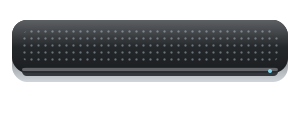
Every other air conditioner cools you by blowing cold air at you. That is the bit people hate, and it is why so many units end up switched off in August. Samsung's answer is a front panel with 23,000 tiny holes in it. The flap closes, the air stops being a draught and starts being a slow, even cold that fills the room from the top down. It is the same refrigeration underneath as anything else. What changes is how the cold reaches you.

F-Gas registered engineers • Free design & heat-load sizing • East Midlands, Lincolnshire & Yorkshire

How it works

The flap closes and the draught stops

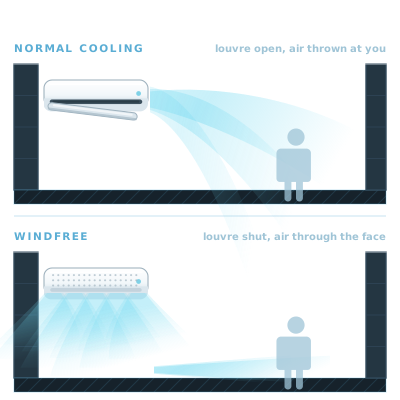
In normal cooling the louvre is open and the unit throws air across the room. Press WindFree and the louvre shuts. The cold air now has to leave through the holes in the face of the unit, so it comes out slowly, spreads sideways and sinks. You end up with a cold room and no moving air on your skin, which are two different things that most people assume are the same.

The same wall unit drawn twice. Above, ordinary cooling with the louvre open throwing a body of cold air sideways across the room. Below, WindFree mode with the louvre shut and the cold seeping out through 23,000 micro-holes in the face of the unit and sinking gently.
Louvre open, the air is thrown at you. Louvre shut, it seeps out of the face and sinks.

The two halves of that drawing are the same machine, one minute apart. Nothing about the refrigeration changes when you press the button. What changes is the last 200mm, where the air either gets pushed at you or is allowed to fall out of the front of the unit under its own weight.

That is why the room still reaches temperature and why it takes longer to get there. Cold air that is not being thrown has to spread on its own.

  1. 1
    It is a mode, not a model

    Every WindFree unit still does ordinary fast cooling. WindFree is a button. Most people run fast cooling to pull the room down, then switch to WindFree and leave it there. That is the pattern we set up at commissioning.

  2. 2
    Why it matters at night

    A draught you would not notice at two in the afternoon is the thing that wakes you at three in the morning. This is the unit we fit most often in bedrooms, and the reason is almost never the efficiency figure.

  3. 3
    It is not a quiet gimmick

    Samsung rate the indoor unit down to 16dB(A) on the wall units. For scale, a library is about 40. At that level what you actually hear in a bedroom is the road outside, not the air conditioning.

  4. 4
    It still heats

    All of these are heat pumps and they run all winter, not just in a heatwave. The heating is where the running cost saving actually shows up, against electric heaters or an old gas boiler warming one room.

Wall units

Three wall units, and the difference is real

They look similar and they are not. The gap between the cheapest and the dearest here is a full efficiency class, which is unusual inside one manufacturer's wall range. All three are R32 and all three do WindFree.

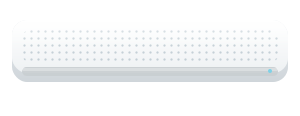
Samsung WindFree Comfort S2 wall-mounted indoor unit in white
AR60FThe way in

WindFree Comfort S2

The entry unit, and the one with the widest capacity span: 2.5, 3.5, 5.2 and 6.8kW. If the room is large, this is the only one of the three that reaches it, which catches people out when they assume the dearest unit is the biggest.

A++ in both cooling and heating, 38dB(A) on high and 16 on low. The same 23,000 micro-holes as the other two. Against the Elite you give up a full efficiency class, the motion sensor and the better filter.

2.5 to 6.8kWSEER 7.90SCOP 4.60A++ / A++38 / 16 dB(A)
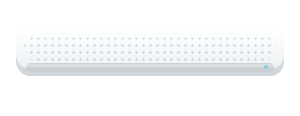
Samsung WindFree Elite S2 wall-mounted indoor unit in white
AR70FThe efficient one

WindFree Elite S2

The most efficient wall unit Samsung sell in the UK, at SEER 9.50, and A+++ in both cooling and heating. On a room that runs most of the day that difference is real money over ten years, and on a bedroom used four hours a night it is pennies. We will tell you which yours is.

The catch is size. It stops at 3.5kW, so it suits bedrooms, studies and small living rooms and runs out of capacity on a big open-plan space. It adds a motion sensor and the Tri-Care filter with its zeolite coating.

2.0 to 3.5kWSEER 9.50A+++ / A+++38 / 16 dB(A)Motion sensor
Samsung WindFree Avant S2 wall-mounted indoor unit in black
AR70FThe one to look at

WindFree Avant S2

The Avant is the one to pick when the unit is going somewhere people actually look. Samsung list the white and the black as two separate units rather than one unit with a colour option, so the black has to be chosen at order.

It is also the quietest of the three on high, at 37dB(A), and it runs the full capacity span up to 6.8kW while holding A+++ cooling. SEER 9.00 and SCOP 4.80, so it heats better than the Elite even though it cools slightly behind it.

2.0 to 6.8kWSEER 9.00SCOP 4.80A+++ / A++White or black
Reading those numbers honestly

SEER is a cooling figure and SCOP is a heating one, and in this country the heating one matters more because the unit runs far more hours in October than it does in July. On that measure the Avant is the strongest of the three. The Elite wins on cooling efficiency and loses on capacity. The Comfort is the one that reaches the big rooms. There is no single best unit here, which is the entire reason we size before we quote.

The detail nobody prints

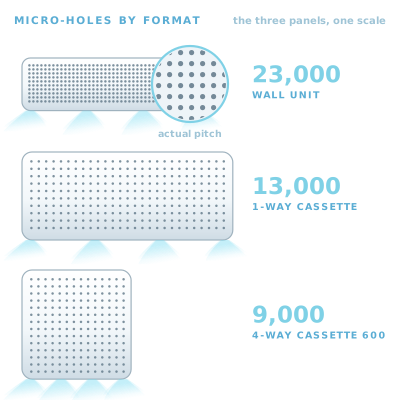
The hole count changes with the format

This is the part almost nobody writes down. WindFree is not one panel reused everywhere. Samsung drill a different number of holes depending on what shape the unit is and how far the air has to travel, and the 360 Cassette does it with no blades at all.

23,000Wall units

Comfort S2, Elite S2 and Avant S2. The air leaves the face of the unit and sinks, so it suits a room you sit still in.

13,0001-Way Cassette

Samsung call this one Still Air². A slim 1,198mm panel only 145mm deep including the fascia, for a ceiling with almost nothing above it.

9,0004-Way Cassette 600

A 620mm square panel that drops into a single ceiling tile, from 1.6kW up to 5.2kW. Four directions, quietly.

Three panels, one for each format, each showing a swatch of micro-holes beside its count: 23,000 for the wall units, 13,000 for the 1-Way Cassette and 9,000 for the 4-Way Cassette 600.
The same idea, drilled three different ways for three different shapes.
The rest of the range

The same cooling, in whatever the ceiling allows

A wall unit is not always possible and is not always wanted. Samsung's residential range covers the usual alternatives, and we fit all of them.

WindFree 4-Way Cassette 600

1.6 to 5.2kW, 33dB(A) on high down to 24 on low. The panel is 620 by 620, so in a suspended ceiling it takes the place of one tile and reads as part of the grid rather than an addition to it.

WindFree 1-Way Cassette

2.6 and 3.5kW, 32dB(A) down to 26. Long and narrow at 1,198 by 500, and only 145mm deep with the panel on. This is the one for a ceiling with too little space above it to take a normal cassette.

360 Cassette

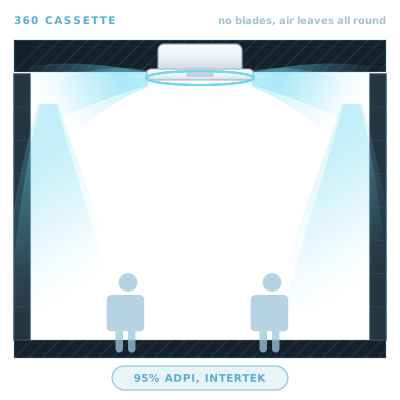
Round, and with no blades in it at all. Air leaves through a circular outlet in every direction at once, which is what removes the cold corner and the hot corner you get from a four-way. Samsung had it tested by Intertek at 95% on the Air Diffusion Performance Index, 11% ahead of a conventional four-way cassette. Square or circular fascia, black or white.

Ducted

3.5 to 14.0kW on the high efficiency duct, 250mm tall, and 22 to 28dB(A). All you see in the room is a grille. The unit and its ducting are hidden above the ceiling, so the space for them has to be planned in, which is why this suits a refurbishment or an extension rather than a retrofit.

Console

2.6, 3.5 and 5.2kW, 720 by 199 by 620, sitting at floor level where a radiator would. 23dB(A) in silent mode. For a room with full-height glazing or a sloping ceiling and no usable wall up high.

Free Joint Multi

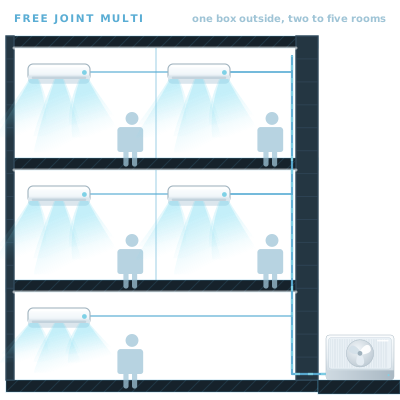
Samsung's multi-split, which they call FJM. One outdoor unit runs two to five indoor units, each with its own controller. One box on the outside wall instead of five, one set of holes through it, and one machine to service each year.

A circular ceiling cassette seen from below with rings of air expanding outwards from it in every direction. It has no blades.
Round, bladeless, and pushing air out in every direction at once.

The 360 is the one worth stopping on. A four-way cassette has four blades throwing air down four sides, which is why you get a cold seat under one of them and a warm corner between two. The 360 has no blades at all and a circular outlet, so the air leaves in every direction evenly.

Samsung had it tested by Intertek and publish an Air Diffusion Performance Index of 95%, which they state is 11% ahead of a conventional four-way. It comes with a square or a circular fascia, in black or white.

More than one room

One outdoor unit, up to five rooms

Samsung call their multi-split Free Joint Multi, or FJM. One outdoor unit runs two to five indoor units and each room keeps its own control, so the bedroom can be off while the lounge is on.

A single outdoor unit on the left with a refrigerant trunk running to five rooms stacked on the right, each with its own wall-mounted indoor unit and its own control.
Two to five rooms, one box outside, one set of holes through the wall.

What usually decides this is not the units inside. It is the outside of the house. Five separate systems means five outdoor units on your walls, five pairs of holes drilled through them and five machines to service every year. A Free Joint Multi is one outdoor unit, one set of holes and one service visit.

The catch is that the rooms share that one outdoor unit, so at any moment they are either all cooling or all heating. Each room still has its own controller and its own temperature, and rooms you are not using can be off. What you cannot do is cool the office while the bedroom next door is being heated. If you need that, it takes a heat recovery system, which is a larger and dearer piece of kit, and we will tell you at survey whether your rooms actually call for one.

Straight answer

Where WindFree is the wrong answer

It is a very good range and it is not the answer to everything. These are the four cases where we would tell you so.

You want it cold, fast, right now

WindFree is deliberately slow. It is the mode you leave running, not the one you use to rescue a room that is already 28 degrees. Every unit here does ordinary fast cooling as well, and that is what you use first.

The room is bigger than 6.8kW

That is the top of the wall range. Above it you are into a cassette, a ducted unit, or more than one indoor unit, and the honest answer is that the survey decides it, not the brochure.

You have been told a figure for your room

SEER 9.50 is measured under a standard test, not in your house. What you actually get depends on the room, the glazing, how long it runs and what temperature you set. We will put numbers against your rooms rather than repeat the label.

Nobody will ever clean it

Easy Filter Plus is genuinely easy, the filter sits in the top of the unit and slides out. It still has to actually happen. A neglected filter costs more efficiency than the gap between any two units on this page.

Why us

Why have ArcticNord fit it?

A WindFree unit installed badly is just an expensive wall unit with a draught. Most of what makes it work happens before anyone opens a box.

We size the room first

A room-by-room heat load, not a guess off the floor area. On a range where the efficient unit stops at 3.5kW and the big one reaches 6.8kW, getting that wrong picks the wrong unit before anything else happens.

We set WindFree up properly

Fast cooling to pull the room down, then WindFree to hold it, with the schedule and the app set before we leave. Left on the default, most people never find the button and conclude the unit is weak.

F-Gas registered engineers

Every system is installed and commissioned by F-Gas registered engineers, with the commissioning record handed over on completion rather than promised.

A fixed written price

Agreed before we start. If the survey changes what the job needs, you hear it then, not on the invoice.

F-Gas Register accredited
F-Gas registered engineers Every installation is carried out and commissioned by F-Gas registered engineers, with the full commissioning record handed over on completion.
Common questions

Samsung WindFree, asked and answered

What is WindFree, in plain English?

The front of the unit has 23,000 small holes in it. In WindFree mode the big louvre closes, so instead of a fan throwing cold air across the room, the cold seeps out through the holes and settles. The room still gets cold. You just do not feel air moving on you.

Is it actually cold, or just less draughty?

It is actually cold. It is the same refrigeration circuit as any other split system, and the same compressor. What changes is how the cold leaves the unit. It gets there more slowly, which is why you run fast cooling first and then switch over.

Which of the three wall units should I have?

If the room is large, Comfort S2 or Avant S2, because the Elite stops at 3.5kW. If the unit will be looked at every day, Avant S2, and it is the only one Samsung list in black. If it is a normal bedroom and running cost is the thing you care about, Elite S2 at SEER 9.50 is the most efficient wall unit Samsung sell here. We size the room before recommending any of them.

Do they heat as well as cool?

Yes, all of them. They are air-to-air heat pumps. In this country they will spend far more hours heating than cooling, which is why we look at the SCOP figure at least as hard as the SEER one.

Can one outdoor unit do several rooms?

Yes. Samsung's multi-split is called Free Joint Multi, or FJM, and one outdoor unit runs two to five indoor units, each room with its own controller. One box on the outside wall instead of five is usually what decides it, particularly on a house where you do not want the front covered in equipment. The one limit is that the rooms sharing that outdoor unit are all cooling or all heating at the same time.

Is the black Avant a different unit or just a colour?

Samsung list it as its own product rather than a finish option on the white one, so it has to be chosen when the order goes in. It is not something that can be changed later.

How quiet is 16dB really?

Quiet enough that it is not what wakes you. A library sits around 40dB. 16dB is the indoor unit on its lowest setting under Samsung's test conditions, so treat it as the floor rather than what you will measure in your bedroom, but the order of magnitude is right.

Do you fit Samsung, or just sell it?

We fit it. F-Gas registered engineers, a room-by-room heat load before anything is quoted, a fixed written price agreed before we start, and the commissioning record handed over at the end.

Also worth a look

How Samsung sits against the rest

We fit nine manufacturers and take nothing from any of them for preferring one. If you want to see where these units land on price and spec against everything else, that is a different page.

Compare the range

Every brand we fit on one scale, including all three WindFree wall units, with a price band and the spec side by side.

Midea Breezeless E

The other draught-free unit we fit, which does the same job through 7,928 micro-holes and adds a UVC sterilisation lamp.

Ceiling cassettes

What a cassette actually involves, whatever the badge on it, including the space it needs above the ceiling and what it hangs from.

Daikin air conditioning

The other full wall range on the site, for anyone cross-shopping the two.

Find out which Samsung your rooms actually need

Send us the rooms, their sizes, which way they face, the glazing, and whether more than one room is involved. We will do the heat load, tell you which of these units suits the building, and put a fixed written price against it before you commit to anything.